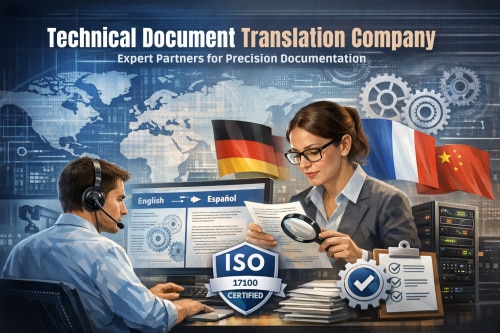
Technical Document Translation Company: Expert Partners for Precision Documentation
Selecting the right technical document translation company determines whether your documentation maintains accuracy, consistency, and compliance across languages. Organizations with complex technical content require translation partners who combine linguistic expertise with domain knowledge, quality management systems, and the technology infrastructure to handle specialized formats and terminology consistently.
What Defines a Technical Document Translation Company
A technical document translation company specializes in converting complex documentation from one language to another while preserving accuracy, terminology consistency, and functional equivalence. Unlike general translation services, these specialized providers maintain teams with subject matter expertise, implement rigorous quality assurance processes, and invest in technology specifically designed for technical content management.
The distinction matters because technical documentation carries higher stakes than general content. Errors in technical translation can cause equipment damage, safety incidents, regulatory non-compliance, or project delays. A dimensional specification translated incorrectly affects manufacturing. Ambiguous safety instructions create liability exposure. Mistranslated regulatory submissions delay market access.
Why Specialization Matters for Technical Content
Technical documents present unique challenges that general translation providers struggle to address. Terminology density requires translators who understand not just terms but the concepts and systems they describe. Format complexity demands capability with CAD files, technical illustrations, and specialized publishing systems. Compliance requirements mean translators must understand regulatory frameworks governing documentation in target markets.
Professional translation services focused on technical content develop infrastructure specifically for these challenges. They recruit translators with engineering, scientific, or technical backgrounds. They implement terminology management systems that ensure consistency across documents and over time. They establish quality processes that catch errors before delivery.
Key Capabilities to Evaluate
Subject matter expertise forms the foundation of technical translation quality. When evaluating a technical document translation company, examine how they recruit and qualify translators for technical projects. According to ISO 17100 standards, translators must demonstrate domain competence beyond linguistic qualifications. Ask providers specifically about translator backgrounds in your industry or technical domain.
Terminology management capabilities differentiate professional technical translation providers from generalists. Effective providers maintain customised glossaries that capture client-specific and industry-specific terminology. These glossaries ensure consistent translation of technical terms across all documents and projects. Translation memory systems store previously approved translations for reuse, preventing terminology drift over time.
Quality assurance processes should be systematic rather than ad hoc. Look for providers implementing structured workflows including mandatory revision by qualified second linguists, technical accuracy verification, and format quality checks. The rigorous review process mandated by ISO 17100 requires a second qualified linguist to compare each translation against the source, verifying accuracy and terminology appropriateness.
Project management capabilities matter for complex technical documentation programs. Evaluate whether providers can handle multiple document types, coordinate across language pairs, maintain consistency across related documents, and scale capacity for large projects. Ask about their experience managing technical documentation programs similar to yours in scope and complexity.
Quality Indicators and Certifications
ISO 17100 certification provides the most relevant quality indicator for translation services. This standard specifies requirements for translator qualifications, revision processes, and quality management systems specific to translation. Unlike general quality certifications, ISO 17100 addresses the unique aspects of translation work including linguistic competence, domain expertise, and bilingual review requirements.
Verify certification claims by requesting copies of certificates and confirming issuing bodies are accredited certification organizations. Legitimate certifications come from bodies accredited by national accreditation organizations. Some providers claim ISO compliance without actual certification—ask specifically whether they hold current certification and from which accrediting body.
Beyond certification, evaluate quality through direct evidence. Request client testimonials from organizations with similar technical translation needs. Ask for case studies demonstrating experience with your document types and industries. Check references specifically about technical accuracy, terminology consistency, and responsiveness to quality concerns.
The accuracy of translations depends on systematic quality processes rather than individual translator skill alone. Ask providers to describe their complete quality workflow from project initiation through delivery. Understand how they handle terminology research, client queries, format preservation, and final quality verification.
Technology and Process Infrastructure
Translation technology infrastructure supports consistency and efficiency for technical documentation programs. Translation memory systems store previously translated content for reuse, ensuring consistent translation of repeated phrases and technical descriptions. For organizations with ongoing documentation needs, this technology reduces costs while improving quality consistency.
Terminology management tools maintain controlled vocabularies that ensure consistent translation of technical terms. These systems integrate with translation workflows, presenting approved terms to translators and flagging inconsistent usage. For technical documentation where precision matters, terminology management provides essential quality control.
File format capabilities determine whether providers can handle your specific documentation types. Technical content often involves specialized formats including CAD drawings, XML-based publishing systems, and engineering software outputs. Ask providers specifically about their experience with formats you use and how they preserve formatting during translation.
Flexibility and adaptability in processes enables providers to accommodate your specific requirements rather than forcing standardized approaches. Evaluate whether providers can integrate with your content management systems, accommodate your review workflows, and adapt to your quality requirements.
Making the Selection Decision
Evaluate providers on dimensions most relevant to your specific technical translation needs. For organizations with specialized terminology, terminology management capabilities may be most critical. For those with complex formats, file handling expertise matters more. For heavily regulated industries, understanding of compliance requirements becomes paramount.
Request detailed proposals that address your specific requirements rather than generic service descriptions. Quality proposals demonstrate understanding of your technical domain, document types, and quality requirements. They specify how the provider will handle your terminology, manage your formats, and ensure accuracy in your subject matter.
Consider the provider relationship as a partnership rather than a transaction. Technical documentation programs benefit from providers who learn your terminology over time, understand your quality expectations, and adapt their processes to your needs. The continuous improvement approach of quality-focused providers means service improves as the relationship develops.
Understanding why professional translation companies outperform alternatives requires recognizing the infrastructure investment that quality technical translation demands. Project management systems, quality assurance workflows, terminology databases, and qualified translator networks represent significant capabilities that individual translators or non-specialized providers cannot match.
Balance quality requirements against practical constraints including budget and timeline. Understand the tradeoffs involved in different service levels. Higher quality services cost more but reduce risk of errors that may cost far more to correct. Discuss options with providers to find approaches that balance quality, cost, and timeline for your specific situation.
Ready to discuss your technical documentation translation needs with a specialized provider? Request a quote to receive a detailed proposal addressing your specific project requirements.
FAQ
Q1. What makes a company qualify as a technical document translation company?
A technical document translation company specializes in translating complex documentation requiring subject matter expertise beyond general linguistic competence. These companies recruit translators with backgrounds in engineering, science, medicine, or other technical fields rather than relying solely on language skills. They implement quality processes specifically designed for technical content, including terminology management systems, specialized quality checks, and format handling capabilities.
Key differentiators include ISO 17100 certification demonstrating systematic quality management, documented translator qualification processes verifying domain expertise, terminology management infrastructure ensuring consistency, and experience with specialized file formats common in technical documentation. General translation providers may handle technical content occasionally, but specialized companies build their entire operation around technical translation requirements.
When evaluating whether a provider qualifies as a technical document translation company, ask about the percentage of their work that involves technical content, their translator recruitment and qualification processes for technical projects, and their specific experience with your document types and industry. Providers focused on technical translation can answer these questions with specific processes and examples rather than generic assurances.
Q2. How important is ISO 17100 certification for technical translation?
ISO 17100 certification provides significant value for organizations acquiring technical translation services. The standard specifies requirements directly relevant to translation quality including translator qualifications, mandatory revision by qualified second linguists, and quality management systems. For technical documentation where accuracy is critical, these systematic requirements provide important risk reduction.
The certification indicates that a translation company has implemented processes for verifying translator competence, conducting bilingual review of all translations, and managing quality systematically. These requirements align directly with what technical documentation demands—qualified translators, verified accuracy, and consistent quality. Organizations can reference ISO 17100 certification as objective evidence of provider capabilities rather than relying solely on self-described qualifications.
However, certification alone does not guarantee perfect translations. Organizations should verify certification validity, understand what scope the certification covers, and evaluate direct evidence of quality including client references and sample work. ISO 17100 certification represents a necessary but not sufficient indicator of quality for technical translation. The best providers combine certification with demonstrated experience in relevant technical domains.
Q3. What questions should I ask when evaluating technical document translation companies?
Effective evaluation requires specific questions that reveal provider capabilities for technical content. Ask how they recruit and qualify translators for technical projects, seeking specific information about required backgrounds, testing procedures, and domain expertise verification. Generic answers about "experienced translators" indicate limited focus on technical specialization.
Inquire about terminology management processes including how they develop and maintain glossaries, ensure consistency across documents, and handle client-specific terminology. Technical translation quality depends heavily on terminology consistency, so providers should describe specific tools and processes rather than general commitments.
Request information about quality assurance workflows beyond generic "quality control" claims. Ask specifically about revision processes, who conducts technical accuracy reviews, how they handle format preservation, and what happens when quality issues are identified. ISO 17100 requires specific quality steps that qualified providers can describe in detail.
Ask for references from clients with similar technical translation needs and follow up with those references about specific aspects of quality, responsiveness, and technical accuracy. Direct feedback from comparable clients provides the most reliable evidence of provider capabilities.
Q4. How do technical document translation companies handle specialized file formats?
Professional technical document translation companies invest in capabilities for handling specialized file formats common in technical documentation. CAD formats including DWG and DXF require extraction of embedded text, translation, and reinsertion while preserving graphical elements. Engineering documentation often uses these formats, and qualified providers have established workflows for handling them.
XML-based publishing formats used in technical documentation systems like DITA require understanding of document structure and the ability to translate within content management workflows. Providers experienced with these formats can integrate with your publishing systems rather than requiring manual extraction and reinsertion of content.
Desktop publishing formats like InDesign and FrameMaker common for technical manuals require preservation of complex layouts during translation. Text expansion in target languages often necessitates layout adjustments, and qualified providers handle these adjustments as part of their service. Ask providers specifically about their experience with your formats and request examples of similar work.
For organizations with unique or proprietary formats, discuss capabilities before committing to a provider. Some technical document translation companies develop custom solutions for specific format requirements, while others may not have the technical capabilities to handle unusual formats effectively.
Q5. What should I expect to pay for technical document translation services?
Technical document translation pricing typically reflects the specialized expertise and quality processes required for technical content. Rates are generally higher than general translation because qualified technical translators command premium compensation, and the quality assurance processes required for technical accuracy add cost. Expect rates 20-50% higher than general translation for comparable language pairs.
Pricing structures vary by provider. Most quote per-word rates that vary by language pair, with common language pairs priced lower than rare combinations. Some providers offer volume discounts for large projects or ongoing programs. Project-based pricing may apply for work involving significant format handling or project management beyond pure translation.
The total cost of technical translation includes more than per-word rates. Consider format handling charges for specialized file types, project management fees for complex programs, and rush charges for urgent timelines. Quality providers present transparent pricing that accounts for all aspects of your project rather than quoting low per-word rates with extensive additional charges.
When evaluating pricing, consider the cost of errors rather than focusing solely on translation rates. Errors in technical documentation can cause significant downstream costs including manufacturing defects, safety incidents, regulatory delays, and customer complaints. Higher-quality translation services typically deliver better value despite higher unit costs.
Links
- Internal:
- technical document translation company
- technical translation
- translation services
- ISO 17100 standards
- customised glossaries
- rigorous review
- ISO 17100
- client testimonials
- accuracy of translations
- Translation memory systems
- Flexibility and adaptability
- continuous improvement
- why professional translation companies
- Request a quote
- External: