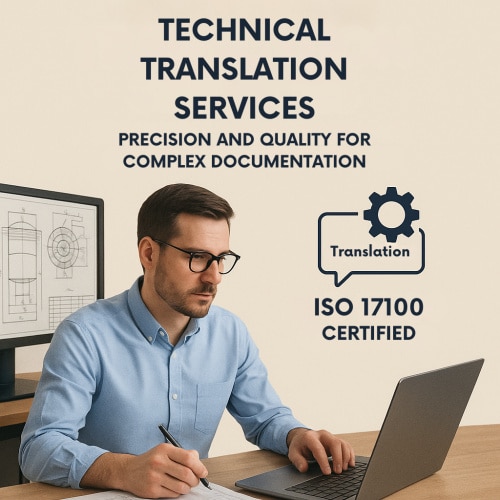
Technical Translation Services: Precision and Quality for Complex Documentation
Technical translation services convert specialized documentation into target languages while preserving accuracy, terminology, and regulatory compliance. Organizations expanding into international markets require translators who understand both linguistic nuances and industry-specific concepts to avoid costly errors in user manuals, engineering specifications, and safety documentation.
What Are Technical Translation Services
Technical translation services involve the conversion of specialized documents from one language to another while maintaining precise terminology, technical accuracy, and industry-specific context. Unlike general translation, this discipline requires translators with subject matter expertise who understand the concepts they are translating, not merely the words.
The scope of technical translation extends across multiple document types: user manuals, product specifications, engineering drawings, safety data sheets, installation guides, maintenance procedures, and regulatory submissions. Each document type carries specific requirements for format preservation, terminology consistency, and compliance with local regulations.
Why Accuracy Matters in Technical Translation
A single mistranslation in a technical document can result in equipment malfunction, safety incidents, regulatory penalties, or product recalls. Consider a pharmaceutical dosage instruction translated incorrectly, or a machinery safety warning that loses its meaning in translation. The consequences extend beyond financial loss to potential harm to end users.
Professional technical translation addresses these risks through systematic quality controls, specialized glossaries, and revision by subject matter experts. The goal is not word-for-word conversion but functional equivalence—ensuring the translated document serves the same purpose as the original.
Industries That Require Technical Translation
Engineering and manufacturing sectors generate substantial volumes of technical documentation requiring translation. Product manuals, assembly instructions, CAD drawing annotations, quality control procedures, and supplier specifications must all be available in the languages of target markets. Companies operating under ISO quality standards often require documentation to meet the same certification requirements across all language versions.
The pharmaceutical and medical device industries face particularly stringent requirements. Regulatory submissions to bodies like the FDA, EMA, or national health authorities must be translated with certified accuracy. Instructions for use, patient information leaflets, and clinical trial documentation require translators familiar with medical terminology and regulatory frameworks.
Information technology presents unique challenges combining technical precision with rapid update cycles. Software documentation, API references, system administration guides, and security protocols require translators who understand programming concepts and can maintain consistency across frequent version updates.
Energy, aerospace, and automotive industries share common needs for translation of safety-critical documentation. Maintenance manuals, operational procedures, and compliance documentation must be translated by professionals who understand the consequences of ambiguity in high-stakes environments.
The Technical Translation Process
Professional technical translation services follow a structured workflow designed to maximize accuracy and consistency. The process begins with project analysis, where linguists assess source materials, identify terminology challenges, and establish glossaries specific to the client and project.
Translation is performed by native translators with demonstrated expertise in the relevant technical domain. According to ISO 17100:2015, translators must hold either a degree in translation or linguistics, an unrelated degree plus two years of professional experience, or five years of full-time translation experience. Subject matter expertise adds another layer of qualification.
Revision constitutes a mandatory step under ISO 17100. A second linguist reviews the translation against the source, checking for accuracy, completeness, and appropriate terminology. This bilingual review catches errors that automated tools cannot detect and ensures the translation functions as intended in its technical context.
Desktop publishing and formatting follow linguistic review. Technical documents often contain diagrams, tables, and specialized layouts that must be preserved in the target language. Professional translation services include formatting to ensure the final deliverable mirrors the original structure.
Quality Assurance in Technical Translation
Quality in technical translation extends beyond linguistic accuracy to encompass terminology management, process compliance, and client-specific requirements. Organizations seeking technical translation services should evaluate providers based on documented quality management systems.
ISO 17100 certification provides an international benchmark for translation quality. The standard specifies requirements for translator qualifications, revision procedures, project management, and client communication. According to ISO documentation, the standard requires translation followed by mandatory revision by a second person, with optional review and proofreading steps for additional quality layers.
Terminology management represents a critical quality component. Translation memory systems store previously approved translations for reuse, ensuring consistency across documents and projects. Termbases capture client-approved terminology, preventing variations that could confuse end users or create compliance issues.
Technical rigour in translation means verifying that measurements, units, numerical values, and technical specifications are converted correctly for the target market. A dimension in inches may need conversion to millimeters; electrical specifications may require adaptation to local standards; chemical concentrations may need different notation systems.
Choosing a Technical Translation Provider
Selecting a technical translation partner requires evaluation across multiple dimensions. Industry experience matters more than general translation volume. A provider with extensive pharmaceutical translation experience may not be the right choice for aerospace documentation, despite technical competence in both domains.
Certification and credentials provide baseline assurance. Beyond ISO 17100, providers may hold ISO 9001 for general quality management or ISO 18587 for post-editing machine translation output. These certifications indicate systematic approaches to quality rather than ad-hoc processes.
Understanding why professional translation companies deliver better outcomes than freelance alternatives involves recognizing the infrastructure behind quality technical translation. Project management, quality assurance workflows, technology platforms, and backup resources all contribute to reliable delivery.
Client references and testimonials from organizations in similar industries provide practical validation. Ask specifically about technical projects, not general translation work. Inquire about handling of urgent requests, response to quality issues, and long-term relationship management.
When evaluating providers, request sample translations or pilot projects to assess quality firsthand. Review their approach to terminology management, revision workflows, and format preservation. Discuss confidentiality protocols, particularly for proprietary technical information.
Ready to discuss your technical documentation requirements? Request a quote to receive a detailed proposal tailored to your industry and document types.
FAQ
Q1. What types of documents require technical translation services?
Technical translation services cover a broad spectrum of specialized documentation across industries. The most common document types include user manuals and operating instructions that accompany products sold in international markets. These documents must communicate complex procedures clearly to end users who may have varying levels of technical knowledge.
Engineering documentation represents another major category, encompassing specifications, drawings, schematics, and technical reports. Manufacturing companies require translation of process documentation, quality procedures, and supplier communications. Safety data sheets, compliance certificates, and regulatory submissions form a critical subset requiring certified translation accuracy.
Software documentation presents unique challenges, including interface strings, help files, API documentation, and technical guides that must maintain accuracy through frequent update cycles. Medical and pharmaceutical documentation requires specialized expertise due to regulatory requirements and the critical nature of healthcare information. Patent applications and intellectual property documentation demand precision in legal and technical terminology simultaneously.
Q2. How does ISO 17100 certification affect translation quality?
ISO 17100:2015 establishes international requirements for professional translation services, directly impacting the quality clients can expect. The standard mandates specific qualifications for translators, including educational credentials or documented professional experience. This ensures that individuals handling technical content possess verified competence rather than self-declared expertise.
The most significant quality impact comes from the mandatory revision requirement. Under ISO 17100, every translation must be reviewed by a second qualified linguist who examines the target text against the source for accuracy, completeness, and appropriate terminology. This bilingual check catches errors that even skilled translators may overlook and provides systematic quality assurance rather than random sampling.
Beyond individual project quality, ISO 17100 certification indicates organizational commitment to documented processes, client communication protocols, and continuous improvement. Certified providers maintain records of translator qualifications, project workflows, and client feedback, enabling systematic quality management rather than reactive problem-solving.
Q3. What industries have the strictest requirements for technical translation?
Pharmaceutical and medical device industries impose the most stringent requirements due to regulatory oversight and patient safety implications. Translations submitted to regulatory authorities must meet certification requirements, with some jurisdictions requiring sworn or notarized translations. Any error in dosage instructions, contraindications, or safety warnings could result in patient harm, making accuracy non-negotiable.
Aerospace and defense industries require translations that maintain safety-critical precision across maintenance manuals, operational procedures, and compliance documentation. Aviation authorities mandate specific documentation standards, and translation errors could compromise aircraft safety. Defense contractors face additional security and confidentiality requirements.
Automotive translation must address safety documentation, regulatory compliance across multiple jurisdictions, and technical precision for maintenance and repair procedures. The automotive industry's global supply chains generate substantial translation volumes with consistent quality requirements. Energy sector documentation, particularly for nuclear facilities, requires translations that maintain safety-critical accuracy while meeting regulatory standards in multiple countries.
Q4. How long does technical translation take?
Technical translation timelines depend on multiple factors including document volume, complexity, language pairs, and quality requirements. As a general benchmark, professional translators working with technical content produce approximately 2,000 to 3,000 words per day while maintaining quality standards. This rate accounts for terminology research, formatting considerations, and self-review by the translator.
The mandatory revision step adds time to any ISO 17100-compliant project. Revision typically requires 50% to 75% of the initial translation time, depending on document complexity and quality requirements. Additional steps such as client review, terminology approval, or specialized formatting extend timelines further.
Urgent projects can be accommodated through resource allocation, but clients should understand the trade-offs. Extremely compressed timelines may require multiple translators working in parallel, which increases coordination requirements and terminology consistency challenges. Professional providers communicate realistic timelines based on project specifications and maintain transparency about quality implications of schedule compression.
Q5. What is the difference between technical translation and localization?
Technical translation focuses on converting source text into target language while maintaining accuracy, terminology, and technical meaning. The primary concern is linguistic and technical fidelity—ensuring the translated document conveys the same information as the original. Technical translation typically preserves the structure, format, and approach of the source document.
Localization extends beyond translation to adapt content for specific markets, considering cultural expectations, regulatory requirements, and local conventions. A localized document may restructure content, change examples to be locally relevant, adapt measurements and units, and modify visual elements to suit target market preferences.
For technical documentation, the distinction often involves regulatory adaptation. A user manual may require translation plus modification of safety symbols, compliance statements, and contact information for the target market. Engineering specifications may need unit conversions and reference to local standards. Both technical translation and localization serve valid purposes; the appropriate approach depends on document type, target audience, and regulatory context.
Links
- Internal:
- technical translation services
- technical translation
- ISO quality standards
- native translators
- translation services
- ISO 17100 certification
- Technical rigour
- why professional translation companies
- testimonials
- Request a quote
- External: