Drug Labeling Translation: Precision for Pharmaceutical Compliance
Drug labeling translation converts pharmaceutical product information into target languages while preserving regulatory accuracy. When a medication reaches international markets, every word on the package insert, carton text, and patient leaflet carries legal and safety implications that require specialized translation expertise.
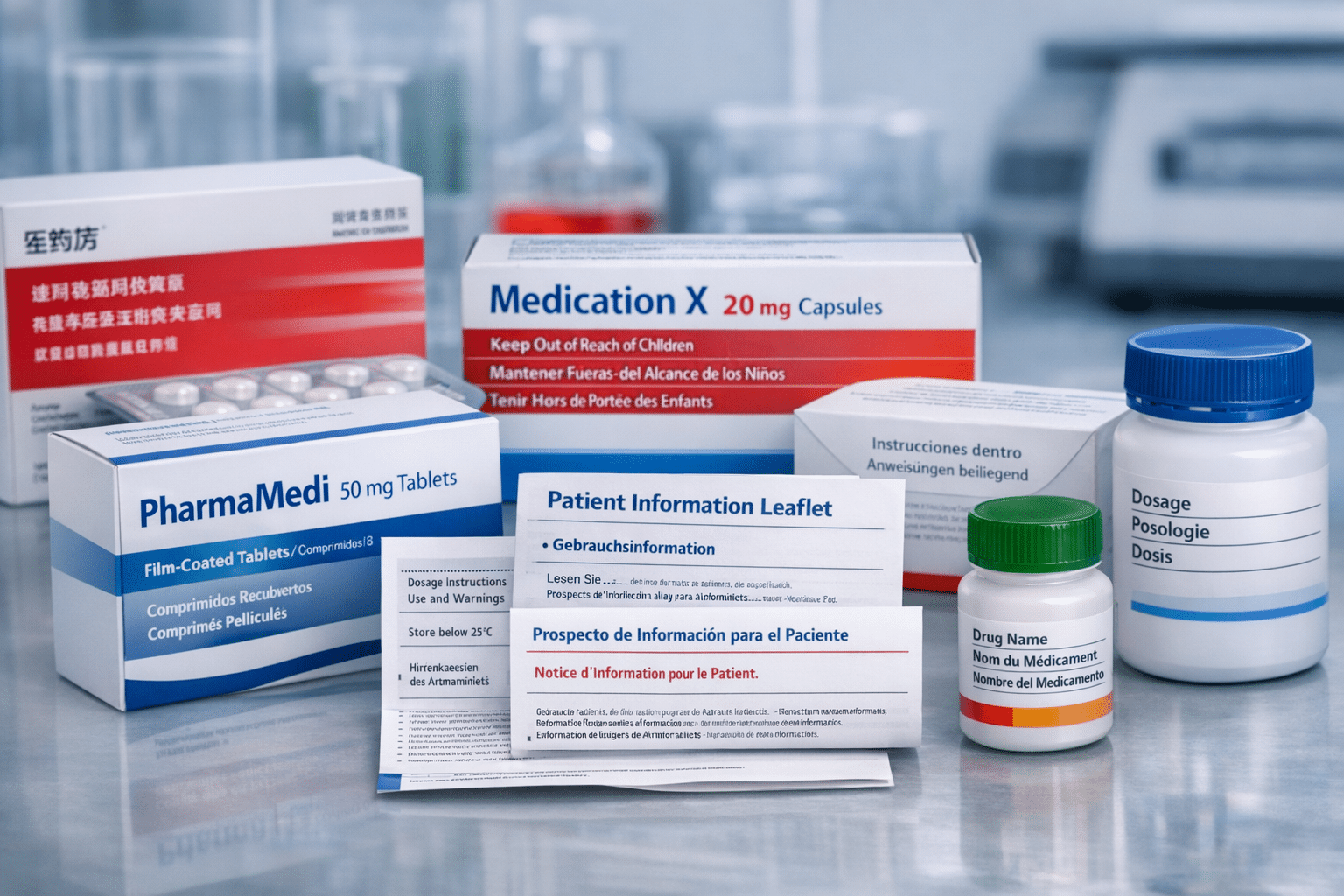
Table of Contents
What Drug Labeling Translation Delivers
Drug labeling translation transforms pharmaceutical documentation from source to target languages while maintaining the precise meaning required for patient safety and regulatory approval. This specialized translation service handles everything from primary packaging text to comprehensive prescribing information documents.
Pharmaceutical manufacturers expanding into new markets face strict linguistic requirements from health authorities. The European Medicines Agency mandates that product information appears in all official languages of member states where the medicine will be marketed. Similarly, national regulators in Brazil, Japan, and other key markets require locally translated labeling before granting market authorization.
The Scope of Pharmaceutical Labeling Content
Drug labeling encompasses several interconnected document types that must maintain consistency across languages. The Summary of Product Characteristics provides healthcare professionals with complete prescribing information including dosage, contraindications, and adverse reactions. Package leaflets communicate essential safety information directly to patients in accessible language.
Carton and container labels present concentrated information within strict space constraints. Each character counts, and translations must fit the physical format while conveying identical meaning. Technical rigour in handling these constraints distinguishes specialized pharmaceutical translators from general language service providers.
Regulatory Framework Requirements
Health authorities worldwide impose specific requirements on drug labeling translation that differ from standard commercial translation standards. The European Medicines Agency publishes detailed guidance on product information requirements, including templates that must be followed precisely in each language version.
Centralized marketing authorization procedures require submission of product information in all EU official languages simultaneously. This creates coordination challenges that only experienced medical and scientific translation teams can manage effectively. Missing a single language version can delay authorization across the entire European market.
FDA Requirements for US Market Entry
The United States Food and Drug Administration mandates English labeling for products sold domestically, but Spanish translations are increasingly expected for medications with significant Hispanic patient populations. FDA regulations specify exactly which labeling elements require translation and how they must be presented.
Puerto Rico represents a particular compliance challenge, requiring full Spanish labeling for all pharmaceutical products. Companies entering this market must ensure their drug labeling translation meets both FDA standards and Spanish language accuracy requirements simultaneously.
Critical Document Types
Pharmaceutical labeling projects typically include multiple document categories that require coordinated translation. Each document type presents distinct challenges related to format, audience, and regulatory scrutiny level.
The Summary of Product Characteristics serves as the foundational reference document for all other labeling materials. This technical document targets healthcare professionals and contains comprehensive information about pharmacology, clinical trial data, and prescribing guidance. Accurate translation requires translators with genuine medical expertise who understand pharmaceutical terminology in both source and target languages.
Patient Information Leaflets demand a different approach. These documents must communicate complex medical information in language accessible to general readers. Translators must balance technical accuracy with readability, ensuring patients can understand dosage instructions, side effects, and warning signs that require medical attention.
Package and Label Text
Primary and secondary packaging text presents unique spatial constraints. Label translations must fit within defined areas while maintaining legibility and including all required elements. This challenge intensifies when translating from compact languages like English into languages requiring more characters to express equivalent meaning.
Certified translations for drug labeling often require attestation that the translated text accurately represents the source document. Regulatory authorities may request translator qualifications and certification documentation as part of the approval package.
Quality Assurance Standards
Drug labeling translation operates under the strictest quality requirements in the translation industry. Errors in pharmaceutical content can directly impact patient safety, making comprehensive quality assurance non-negotiable for responsible language service providers.
ISO 17100 certification establishes the baseline quality framework for professional translation services. This international standard requires qualified translators, mandatory revision by a second linguist, and documented quality processes. For pharmaceutical content, ISO 17100 compliance represents the minimum expectation rather than a differentiator.
Beyond standard certification requirements, drug labeling translation demands specialized quality procedures. These include terminology verification against approved glossaries, cross-reference checking between related documents, and format validation to ensure translated text fits physical packaging constraints.
The TEP Process in Pharmaceutical Context
Translation, editing, and proofreading form the core workflow for pharmaceutical content. Each stage serves a distinct purpose in ensuring accuracy. Translation captures meaning accurately in the target language. Editing verifies terminology consistency and regulatory compliance. Proofreading catches formatting issues and typographical errors before final delivery.
M21Global’s zero errors commitment reflects the quality expectations appropriate for pharmaceutical documentation. When patient safety depends on translation accuracy, acceptable error rates approach zero.
Terminology Consistency Challenges
Pharmaceutical terminology presents persistent challenges across languages. Drug names, anatomical terms, and therapeutic categories require consistent translation throughout a product’s documentation and across its entire lifecycle. Inconsistency between labeling documents can trigger regulatory queries and delay market authorization.
Customised glossaries capture approved translations for key terms and ensure consistency across projects and time. These living documents grow as new products enter development and regulatory guidance evolves. Managing terminology databases requires specialized translation memory systems and disciplined glossary maintenance procedures.
Generic drug names follow international conventions that vary by region. The International Nonproprietary Name system provides a framework, but actual usage differs between markets. Translators must navigate these variations while maintaining accuracy and regulatory compliance.
Handling Updates and Variations
Drug labeling evolves throughout a product’s commercial life. Safety updates, formulation changes, and new indications require corresponding labeling modifications in all marketed languages. Translation providers must maintain version control systems that track changes and ensure updates propagate correctly across all language versions.
Continuous improvement processes help identify and correct terminology inconsistencies before they compound across documents. Regular review cycles and client feedback integration strengthen translation quality over time.
Selecting a Translation Partner
Choosing a drug labeling translation provider requires evaluation beyond standard translation vendor criteria. Pharmaceutical experience, regulatory knowledge, and quality certifications all factor into the selection decision.
Verify that potential providers hold ISO 17100 certification and can demonstrate pharmaceutical project experience. Request references from pharmaceutical clients and examples of similar labeling projects they have completed. Ask about their translator qualification requirements and subject matter expertise verification procedures.
Evaluate their technology infrastructure for managing pharmaceutical terminology. Effective translation memory systems and glossary management tools improve consistency and reduce long-term costs. Ask how they handle version control and coordinate updates across multiple language versions.
Assessing Regulatory Expertise
Client testimonials provide insight into real-world performance on pharmaceutical projects. Look for specific mentions of regulatory submission experience, timeline reliability, and responsiveness to urgent requests. The pharmaceutical industry operates under strict deadlines, and translation delays can cascade through regulatory approval timelines.
Ready to discuss your drug labeling translation requirements? Request a quote to receive a detailed proposal tailored to your pharmaceutical documentation needs.
FAQ
What qualifications should drug labeling translators possess?
Drug labeling translators should combine linguistic expertise with pharmaceutical or medical background. Ideally, translators hold degrees in pharmacy, medicine, or life sciences alongside translation qualifications. This dual competence ensures they understand both the technical content and the regulatory context in which labels will be reviewed.
ISO 17100 certification requires translators to demonstrate competence through recognized qualifications or equivalent professional experience. For pharmaceutical content specifically, experience with EMA or FDA submission processes adds significant value. Translators familiar with regulatory templates and terminology conventions work more efficiently and produce more accurate results.
Many pharmaceutical companies also require translators to sign confidentiality agreements and may specify additional qualifications based on therapeutic area. Oncology labeling, for example, demands familiarity with cancer terminology and treatment protocols that general medical translators may lack.
How long does drug labeling translation typically take?
Drug labeling translation timelines depend on document volume, language count, and complexity. A typical Summary of Product Characteristics translation into a single language requires five to seven business days when following proper quality procedures including translation, editing, and proofreading stages.
Multi-language projects for EU centralized procedures, which require simultaneous submission in twenty-four languages, demand careful planning and parallel workflow management. These comprehensive projects typically require four to eight weeks depending on document scope and coordination requirements.
Urgent timeline requests are common in pharmaceutical contexts, particularly for safety updates requiring rapid communication to healthcare professionals and patients. Experienced translation partners maintain capacity for expedited projects while preserving quality standards. However, rushing complex pharmaceutical translations increases error risk, so realistic timeline planning benefits all parties.
What happens if labeling translation errors are discovered after approval?
Labeling translation errors discovered post-approval trigger correction procedures that vary by jurisdiction and error severity. Minor typographical errors may be corrected through variation procedures during routine label updates. More significant errors affecting safety information require urgent regulatory notification and may necessitate product recalls.
The European Medicines Agency classifies labeling changes by their impact on product safety and efficacy. Type IA variations cover minor changes that can be implemented quickly, while Type II variations require full assessment before implementation. Translation errors affecting therapeutic information typically require Type II variation procedures.
Preventing post-approval corrections through rigorous quality assurance proves far more cost-effective than remediation. Comprehensive review procedures, terminology verification, and back-translation quality checks significantly reduce error risk before regulatory submission.
Should drug labels include back-translation for quality verification?
Back-translation serves as a quality verification tool for pharmaceutical documentation, particularly for patient-facing materials and critical safety information. The process involves translating the target language text back into the source language by an independent translator who has not seen the original document. Comparing the back-translation against the source reveals meaning shifts or ambiguities.
Regulatory authorities do not universally mandate back-translation, but many pharmaceutical companies include it in their standard operating procedures. The FDA has historically expected back-translation for clinical trial materials used with non-English speaking participants, establishing precedent that extends to commercial labeling.
Back-translation adds cost and time to translation projects but provides documented quality evidence. For high-risk content or markets with stringent regulatory oversight, the investment in back-translation quality verification typically justifies itself through reduced correction costs and regulatory query responses.
How do you handle drug labeling translation for combination products?
Combination products containing multiple active substances require coordinated labeling translation that maintains consistency with each component’s established terminology. When combined products include substances with existing translations in the target market, labeling must align with previously approved language while addressing the combination’s unique characteristics.
Fixed-dose combinations present particular challenges because dosage information, interaction warnings, and contraindications apply to the combined formulation rather than individual components. Translators must understand pharmacological interactions to accurately convey safety information specific to the combination.
Device-drug combinations add complexity by introducing medical device terminology alongside pharmaceutical content. Labeling for such products must satisfy both pharmaceutical and device regulatory requirements, sometimes from different regulatory bodies within the same jurisdiction. Translation teams familiar with both regulatory frameworks navigate these requirements more effectively.
What role does translation memory play in drug labeling projects?
Translation memory systems store previously translated segments for reuse in future projects, providing consistency and efficiency benefits particularly valuable in pharmaceutical contexts. When labeling updates occur, translation memory identifies unchanged content and flags modified sections requiring new translation.
For product families sharing similar characteristics, translation memory ensures consistent terminology across related medications. When a pharmaceutical company expands a therapeutic line, memory leverage reduces translation time and cost while maintaining linguistic consistency patients and healthcare professionals expect.
Effective translation memory management requires disciplined maintenance procedures. Outdated translations must be flagged or removed when terminology evolves. Regular alignment between glossaries and translation memory content prevents conflicts that could introduce inconsistencies into new projects. Professional pharmaceutical translation providers invest significantly in memory management infrastructure.