Pharma Regulatory Translation: Ensuring Compliance for Global Market Authorization
Pharma regulatory translation converts critical drug registration documentation to meet the stringent requirements of authorities like the EMA, FDA, and national health agencies such as INFARMED. Companies seeking marketing authorization across multiple jurisdictions depend on translation accuracy to avoid delays, queries, and potential rejection of their submissions.
Table of Contents
- What Pharma Regulatory Translation Delivers
- Document Types Requiring Regulatory Translation
- EMA Linguistic Review Requirements
- EMA Centralised vs Decentralised Procedure Translation
- INFARMED National Variations and Post-Authorization Updates
- Quality Standards for Regulatory Translation
- Selecting a Pharma Regulatory Translation Provider
- FAQ
What Pharma Regulatory Translation Delivers
Pharma regulatory translation transforms drug registration dossiers, product information, and clinical documentation into the languages required by regulatory authorities worldwide. Unlike general medical translation, this discipline demands precise adherence to agency-specific templates, terminology standards, and submission formats that vary by jurisdiction.
The stakes are substantial. Translation errors in regulatory submissions can trigger validation queries, delay marketing authorization timelines by months, or result in outright rejection of applications. For pharmaceutical companies investing years and significant resources in drug development, the accuracy of translated submissions directly affects time-to-market and competitive positioning.
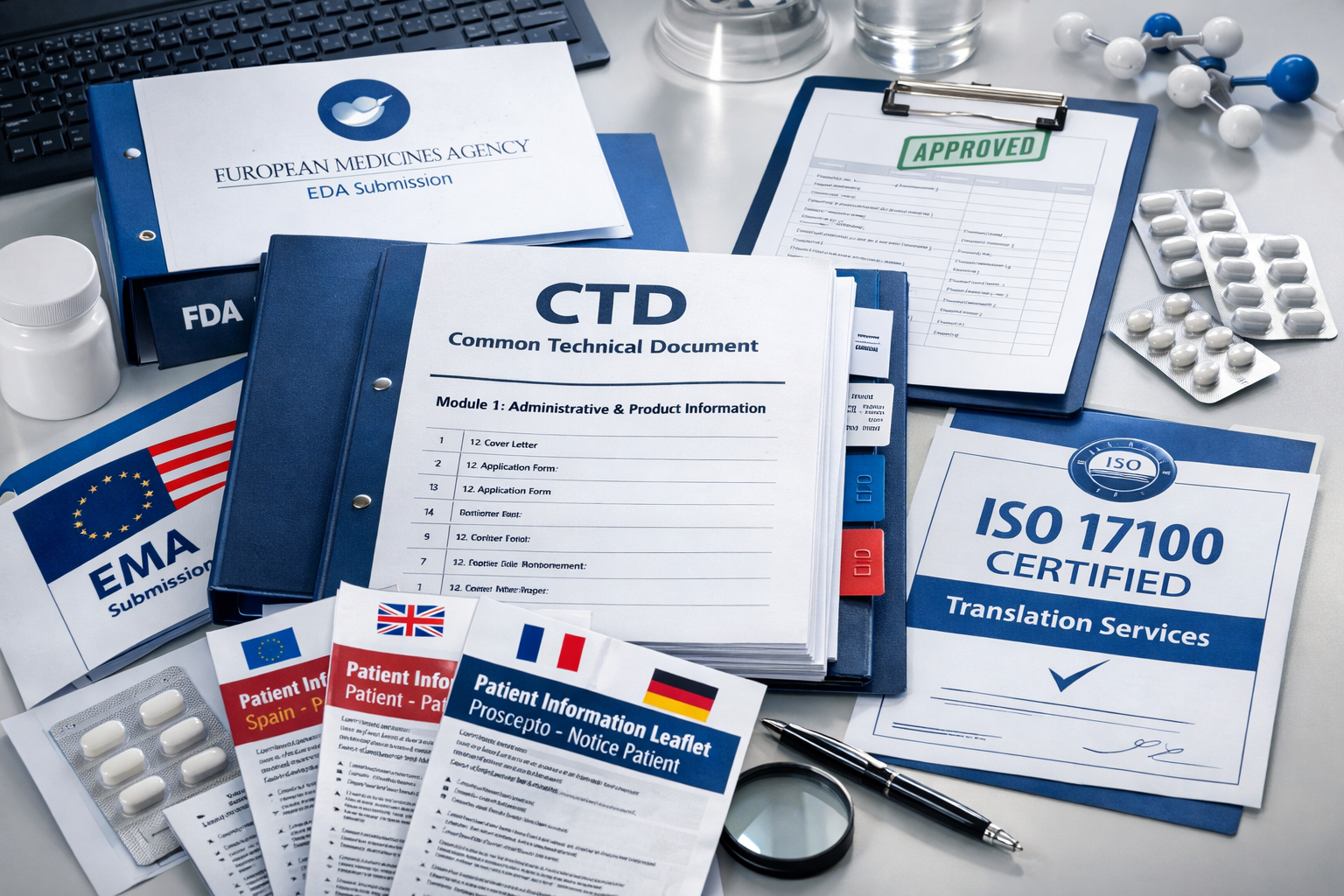
Translation services supporting regulatory submissions must demonstrate expertise in the Common Technical Document (CTD) format standardized by the International Council for Harmonisation (ICH). The CTD organizes submission content into five modules covering administrative information, quality summaries, nonclinical data, and clinical study reports.
The CTD Framework and Pharma Regulatory Translation Requirements
The Common Technical Document provides a harmonized structure for pharmaceutical registration across the EU, US, Japan, and other ICH regions. Module 1 contains region-specific administrative documents and product information, while Modules 2 through 5 present standardized technical content.
Pharma regulatory translation focuses heavily on Module 1 materials, including the Summary of Product Characteristics (SmPC), Patient Information Leaflet (PIL), and labeling text. These documents require translation into all official languages of markets where the drug will be sold. For EU-wide authorization through the centralized procedure, this means preparing translations in 24 official languages. A well-structured drug registration dossier translation workflow treats these modules as distinct tracks with their own terminology controls and review cycles.
Document Types Requiring Regulatory Translation
Regulatory submissions encompass diverse document categories, each with specific translation requirements and quality expectations. Medical and scientific translation expertise forms the foundation, but regulatory work adds layers of compliance complexity.
Summary of Product Characteristics (SmPC): The SmPC provides prescribing information for healthcare professionals. It contains details on indications, dosage, contraindications, adverse reactions, and pharmacological properties. The EMA requires SmPC translations to follow Quality Review of Documents (QRD) templates that standardize formatting and certain terminology across languages.
Patient Information Leaflet (PIL): The PIL communicates essential safety and usage information directly to patients. Readability requirements demand clear, accessible language at appropriate literacy levels. Regulatory authorities assess whether translated PILs enable patients to use medications safely and correctly. Dedicated drug labeling translation workflows ensure the language used on cartons, leaflets and container labels stays aligned with the approved SmPC throughout the product life cycle.
Labeling and Packaging Text: Carton labels, blister packs, and container labels must display required information in local languages. Space constraints impose strict character limits, requiring translators to convey complete information concisely.
Clinical Study Reports: Submissions include translated protocols, informed consent forms, and clinical outcome assessments for multinational trials. Scientific translation of these materials demands understanding of study design, statistical methods, and regulatory expectations for data presentation. Teams that specialise in clinical documentation translation apply consistent terminology and QC checks across protocol, investigator brochure and clinical study report so that what reaches the agency reads as a single coherent dossier.
Variations and Post-Authorization Updates: After initial approval, pharmaceutical companies submit variations to update product information based on new safety data, manufacturing changes, or labeling revisions. Each variation requires corresponding translation updates across all authorized languages.
EMA Linguistic Review Requirements
The European Medicines Agency mandates linguistic review of product information translations for medicines authorized through the centralized procedure. This process occurs during the final phase of marketing authorization, after the Committee for Medicinal Products for Human Use (CHMP) issues a positive opinion.
The linguistic review timeline is demanding. Following CHMP opinion, marketing authorization holders have approximately five days to submit complete translations in all 24 EU languages. National competent authorities then review translations for accuracy, fluency, and compliance with local conventions. Feedback must be incorporated and final versions submitted by Day 235 of the authorization procedure. Experienced EMA submission translation services front-load terminology preparation during the assessment phase so that the five-day window is reserved for final adjustments rather than primary translation.
Continuous improvement in translation workflows becomes essential for meeting these compressed timelines. Companies that initiate translation work during the assessment phase position themselves to respond quickly after positive opinion, reserving the five-day window for final adjustments rather than primary translation.
The EMA's QRD templates specify fonts, formatting, section headings, and standardized translations for certain terms. Translators must work within these constraints while ensuring the translated text accurately conveys source content. Deviations from template requirements trigger queries and revision cycles that consume limited timeline.
EMA Centralised vs Decentralised Procedure Translation
Pharmaceutical sponsors can seek European authorization through several regulatory routes, and each route shapes the translation workload in a distinct way. Understanding the translation implications of each pathway helps regulatory and localization teams budget realistic timelines and language coverage before filing.
The centralised procedure, coordinated by the European Medicines Agency, produces a single marketing authorization valid across all EU member states, plus Iceland, Liechtenstein and Norway. It is mandatory for products covered by Regulation (EC) No 726/2004, including biotechnology-derived medicines, advanced therapies, orphan drugs and new active substances for certain indications. Because one decision covers the whole EU, the translation footprint is broad from day one. Product information must be delivered in all 24 official EU languages, plus Icelandic and Norwegian, typically within the Day 215 to Day 235 linguistic review window after a positive CHMP opinion. Specialist pharmaceutical compliance translation teams treat this window as a project phase of its own, with prepared terminology and parallel reviewers standing by.
The decentralised procedure (DCP) and the related mutual recognition procedure (MRP) are member-state-led routes used when centralised authorization is not mandatory. A sponsor nominates a reference member state (RMS) that leads the assessment and one or more concerned member states (CMS) that recognize the RMS outcome. The translation workload scales with the number of CMS selected rather than covering the full EU: typically the source language of the dossier (often English) plus the national language of each RMS and CMS. Timelines are tighter in a different way: sponsors have to manage staggered national approval steps, each of which can trigger its own labelling and leaflet update in the relevant language.
For sponsors choosing between routes, the translation impact is rarely the deciding factor, but it is rarely trivial either. Centralised procedures front-load a large, time-compressed multilingual workload around the CHMP opinion. Decentralised and mutual recognition procedures spread a smaller workload across more calendar time, but introduce national variability in review comments and template expectations. In both cases, the approved English master text drives every downstream language version, so terminology and style decisions made during the assessment phase propagate across all target languages.
| Agency | Submission types | Languages required | Typical timeline |
|---|---|---|---|
| EMA (centralised procedure) | Marketing Authorization Application (MAA), Type IA/IB/II variations, renewals, PSURs | 24 official EU languages, plus Icelandic and Norwegian for EEA countries, on product information and labelling | 210-day scientific review, followed by linguistic review from Day 215 to Day 235 after CHMP positive opinion |
| EMA (decentralised / mutual recognition) | DCP or MRP application with a Reference Member State and selected Concerned Member States, national variations | Source language (typically English) plus the national language of each Reference and Concerned Member State | Approximately 210 days for the assessment phase, plus national phase timelines that vary by member state |
| FDA (United States) | IND, NDA, BLA, ANDA and related supplements under 21 CFR, eCTD format | English as the primary submission language | Standard NDA review of 10 months from filing; priority review in 6 months |
| INFARMED (Portugal) | National marketing authorizations, DCP/MRP national phase, Type I and Type II variations, national labelling updates | European Portuguese for Resumo das Caracteristicas do Medicamento (RCM), Folheto Informativo (FI), and national labelling | National variation review timelines typically range from 30 to 90 days depending on variation type and complexity |
The table highlights why route selection and language planning must happen together. A centralised submission is, in practice, a 26-language exercise compressed into three weeks of linguistic review. A decentralised submission with three CMS is a four-language exercise spread across a longer calendar, but with more national variation in feedback. An FDA submission is a largely monolingual exercise. A national INFARMED filing is a Portuguese-only exercise, but with the full weight of national template and terminology expectations. Sponsors that plan the language dimension alongside the regulatory strategy tend to avoid late-stage surprises, because the translation budget, the linguist availability, and the quality controls can be matched to the specific footprint of each route before the clock starts.
INFARMED National Variations and Post-Authorization Updates
INFARMED, the Autoridade Nacional do Medicamento e Produtos de Saude, is the Portuguese national authority responsible for authorizing and supervising medicines and health products placed on the Portuguese market. It acts as a Reference or Concerned Member State in European procedures, and it also runs purely national authorizations for products outside the centralised scope. For any product with a presence in Portugal, INFARMED is the endpoint where translation quality and regulatory compliance finally meet the patient.
Product information submitted to INFARMED must appear in European Portuguese. The Resumo das Caracteristicas do Medicamento (RCM) is the Portuguese-language equivalent of the SmPC, the Folheto Informativo (FI) is the Portuguese PIL, and national labelling, including cartons, blisters, and secondary packaging, must likewise appear in European Portuguese. Translators working into Portuguese for INFARMED must observe INFARMED-specific conventions for drug names, dosage forms, routes of administration, and standardized warning phrases. Subtle choices such as whether to use "comprimido revestido por pelicula" versus "comprimido pelicular", or how to present dose strengths, can surface as reviewer queries if they diverge from prior approved texts.
Post-authorization activity represents the bulk of ongoing INFARMED translation work. Variations under Regulation (EC) No 1234/2008 fall into Type IA (minor, notification), Type IB (minor, approval required), and Type II (major, full assessment) categories, and most variations touch either the SmPC, PIL, or labelling in some way. A change in excipients, a new safety warning agreed at EU level, an updated storage condition or a new pack size each triggers a cascade of translation updates. For sponsors with long-established products in Portugal, the cumulative volume of variation translation can exceed the original MAA translation several times over during the product life cycle. Structured pharmacovigilance report translation processes keep periodic safety updates, signal evaluations and risk management plan updates aligned with the latest approved Portuguese-language texts.
INFARMED also enforces alignment between the Portuguese RCM/FI and the reference texts approved by the EMA or the Reference Member State. Divergences introduced during translation, however small, can trigger queries during national phase assessment or during subsequent variations. For this reason, translation memories and approved glossaries for INFARMED work should be treated as living assets: updated with every approval, reviewed against the latest EMA template version, and shared with every linguist who touches the product.
Quality Standards for Regulatory Translation
Regulatory translation demands documented quality assurance processes that can withstand agency scrutiny. ISO 17100 certification establishes baseline requirements for translation service providers, including translator qualifications, revision workflows, and project management procedures.
For pharmaceutical work, ISO 17100 compliance provides necessary but not sufficient quality assurance. Pharma regulatory translation requires additional safeguards including subject-matter expertise verification, terminology validation against approved glossaries, and format-specific quality checks.
Translator Qualification Requirements
Pharma regulatory translators should be specialist linguists with proven translation experience in the pharmaceutical and life-sciences domain. ISO 17100 requires translators to hold recognized translation qualifications or equivalent education combined with documented experience. For regulatory work, sustained exposure to pharmacy, medicine, or life-sciences source texts strengthens the translator's ability to understand source content and produce accurate translations.
Technical translation skills complement pharmaceutical knowledge, as regulatory documents often include complex manufacturing processes, analytical methods, and quality control specifications. Native translators working into their mother tongue ensure natural expression and cultural appropriateness, particularly important for patient-facing materials where readability directly affects medication safety.
Revision and Quality Control
For high-risk regulatory submissions, the Strategic service tier applies ISO 17100 full revision, where a second qualified linguist independently reviews the translation against the source before delivery. This independent review catches errors, inconsistencies, and departures from source meaning that the original translator may have missed.
For regulatory submissions, additional quality control steps often include back-translation of critical content, comparison against previously approved texts, and specialist review by pharmacists or physicians familiar with the therapeutic area. These measures reflect the consequence of errors, where incorrect dosage instructions or missing safety warnings could harm patients.
Selecting a Pharma Regulatory Translation Provider
Choosing a translation partner for regulatory submissions requires evaluating technical capability, regulatory experience, and operational readiness for demanding timelines. Understanding why professional translation companies outperform alternatives becomes especially relevant when submission deadlines and market access are at stake.
Regulatory Expertise: Providers should demonstrate documented experience with EMA, FDA, INFARMED and other relevant regulatory authorities. This includes familiarity with QRD templates, CTD structure, and agency-specific requirements that affect translation approach.
Quality Certification: ISO 17100 certification provides evidence of systematic quality management. Ask for certification documentation and understand what scope the certificate covers, as some providers maintain certification only for certain language pairs or service types. M21Global holds ISO 17100 certification audited by Bureau Veritas, built on more than two decades of specialist linguistic work. The ISO 17100 standard defines requirements for core processes, resources, and quality management in translation services.
Terminology Management: Effective providers maintain customised glossaries capturing client-approved terminology, regulatory preferred terms, and product-specific vocabulary. Translation memory systems ensure consistency across documents and over time.
Timeline Performance: Request references from pharmaceutical clients and inquire specifically about the provider's performance during time-critical submission phases. The ability to mobilize qualified translators across multiple languages simultaneously determines whether tight linguistic review deadlines can be met.
Confidentiality and Security: Drug development information represents sensitive commercial intelligence. Providers should demonstrate appropriate data security measures and willingness to execute confidentiality agreements that meet pharmaceutical industry standards.
Client testimonials from pharmaceutical and biotechnology companies offer insight into real-world performance. Look for feedback addressing regulatory-specific concerns such as agency query rates, timeline adherence during submissions, and responsiveness to urgent revision requests.
Ready to discuss your pharma regulatory translation requirements? Request a quote to begin the conversation about your upcoming submissions and how professional translation support can protect your authorization timeline.