
- Key pharmacovigilance document types requiring translation
- Linguistic requirements: INFARMED and the EMA
- Common errors in pharmacovigilance translation
- Structuring the translation process for regulatory submissions
- Pharmacovigilance translation with M21Global
- Related Services
- Frequently Asked Questions
Submitting pharmacovigilance reports to regulatory authorities requires translations that meet precise technical and legal standards. A terminology error in a PSUR or an ICSR is not simply a linguistic imprecision: it can delay an assessment, trigger clarification requests, or undermine the document's validity before INFARMED or the EMA.
Key pharmacovigilance document types requiring translation
Pharmacovigilance is the ongoing process of monitoring medicine safety after market authorisation. The reports produced follow formats defined by ICH guidelines and European legislation, principally Regulation (EC) No 726/2004 and Directive 2001/83/EC.
The main documents that require translation include:
- PSUR (Periodic Safety Update Report): submitted to the EMA and national authorities on a defined schedule. Includes benefit-risk analysis, exposure data, and safety signal review.
- ICSR (Individual Case Safety Report): individual safety case notification submitted via EudraVigilance. The translation must preserve the MedDRA terms used in adverse event coding with complete accuracy.
- RMP (Risk Management Plan): strategic document defining risk minimisation measures. A Portuguese-language version is required for INFARMED submissions when the medicine is authorised in Portugal.
- DSUR (Development Safety Update Report): safety report for medicines in clinical development, relevant when trials are conducted in Portugal or elsewhere in the EU.
- Signal assessment reports and PADERs: documents supporting regulatory decision-making, characterised by dense technical terminology.
Each format has structural and terminological conventions that the translator must understand before starting the work.
Linguistic requirements: INFARMED and the EMA
The EMA accepts most pharmacovigilance documents in English under the centralised procedure. However, when a submission involves the national or mutual recognition procedure, INFARMED may require Portuguese versions of specific documents, most commonly the Risk Management Plan and executive summaries of PSURs.
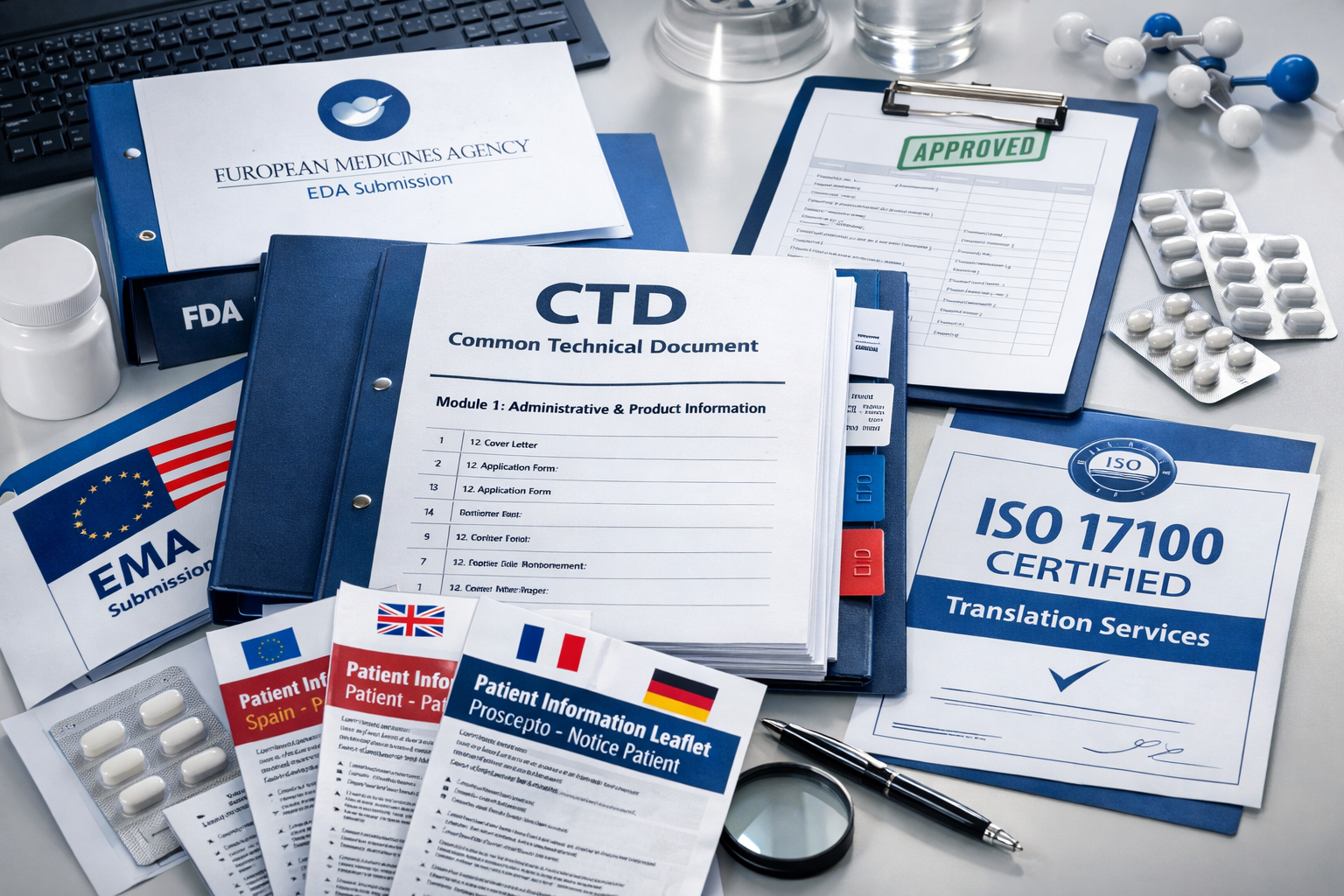
For INFARMED submissions, sworn translation is generally not required in pharmaceutical regulatory contexts. What is required is that translations are carried out by translators with demonstrable expertise in the field and, ideally, by a provider with a documented quality management process. ISO 17100:2015 certification is the standard that marketing authorisation holders (MAHs) use to demonstrate that their translation provider operates a verifiable process.
Documents submitted to the EMA under the centralised procedure must follow the EMA Style Guide and respect MedDRA terminology, EDQM Standard Terms, and ICH E2 guidelines for safety reporting. Any terminological deviation may be flagged during scientific assessment, which is why pharmacovigilance work is best handled as part of a broader regulatory translation process with shared glossaries and documented quality control across the full dossier.
It is also worth verifying whether the document requires review by a regulatory affairs specialist or pharmacovigilance expert, not just linguistic review. For complex documents such as a PSUR covering a product with an extensive safety profile, review by a pharmacist or physician with pharmacovigilance experience is a recognised best practice.
Common errors in pharmacovigilance translation
Most problems identified in this type of translation result from inadequate terminology decisions or insufficient knowledge of the regulatory context.
The most frequent errors include:
- Free translation of MedDRA terms: MedDRA terms have official equivalents in all 24 EU languages. Replacing an official term with a paraphrase can prevent correct adverse event coding.
- Inconsistency across documents in the same dossier: the PSUR must use exactly the same terminology as the SmPC, the RMP, and associated ICSRs. If different sections of the dossier are translated by different providers without a shared glossary, inconsistencies arise that complicate regulatory review.
- Disregarding EMA formatting conventions: headings, section numbering, and abbreviations follow specific conventions that must be preserved in the target language.
- Alterations to numerical values or units: in a medicine exposure table or a statistical safety analysis, any change to a numerical value or unit has direct consequences for how the document is interpreted.
- Translating annexes without full document context: annexes in a PSUR frequently cross-reference sections in the main body. Translating annexes in isolation, without access to the complete document, increases the risk of inconsistencies.
Similar terminological challenges arise in translating clinical trial protocols for regulatory submission, and the same quality control principles apply.
Structuring the translation process for regulatory submissions
A sound process for pharmacovigilance document translation has four essential components.
First, a validated terminology glossary for the specific product, covering the applicable MedDRA terms, the International Nonproprietary Name (INN), the brand name, and recurring technical terms across the dossier. This glossary should be built during the first translation project and maintained for all subsequent submissions.
Second, a TEP process (translation, editing, proofreading) carried out by professionals with training in pharmaceuticals or life sciences. Editing should be performed by a second specialist translator; the final proofreading step should include a consistency check against the validated glossary.
Third, content review by a subject-matter expert when the document involves benefit-risk evaluation, signal interpretation, or clinical analysis. Linguistic review does not substitute for scientific content review.
Fourth, document management that ensures traceability: version control, dates, names of professionals involved, and records of terminology decisions. In the event of an audit or a clarification request from the regulatory authority, these records are critical.
The same process applies to drug labelling translation, where consistency between the SmPC, the package leaflet, and the outer packaging is a regulatory requirement.
Pharmacovigilance translation with M21Global
M21Global provides pharmaceutical translation services certified to ISO 17100:2015, with translators specialised in life sciences and familiar with the requirements of INFARMED, the EMA, and ICH guidelines. The workflow includes product-specific glossary management, documented quality control, and full process traceability.
If your organisation has a pharmacovigilance submission to prepare, contact M21Global for a quote: provide the document type, estimated volume, and submission deadline, and you will receive a specific proposal for the project.
Related Services
Request a free medical translation quote