Submitting a marketing authorisation dossier to the European Medicines Agency is a precise regulatory undertaking. Translation quality within that dossier is not a secondary concern: terminological inconsistencies between CTD modules, or deviations from EMA templates, generate questions from assessors that can set a submission back by months.
What the CTD contains and what requires translation
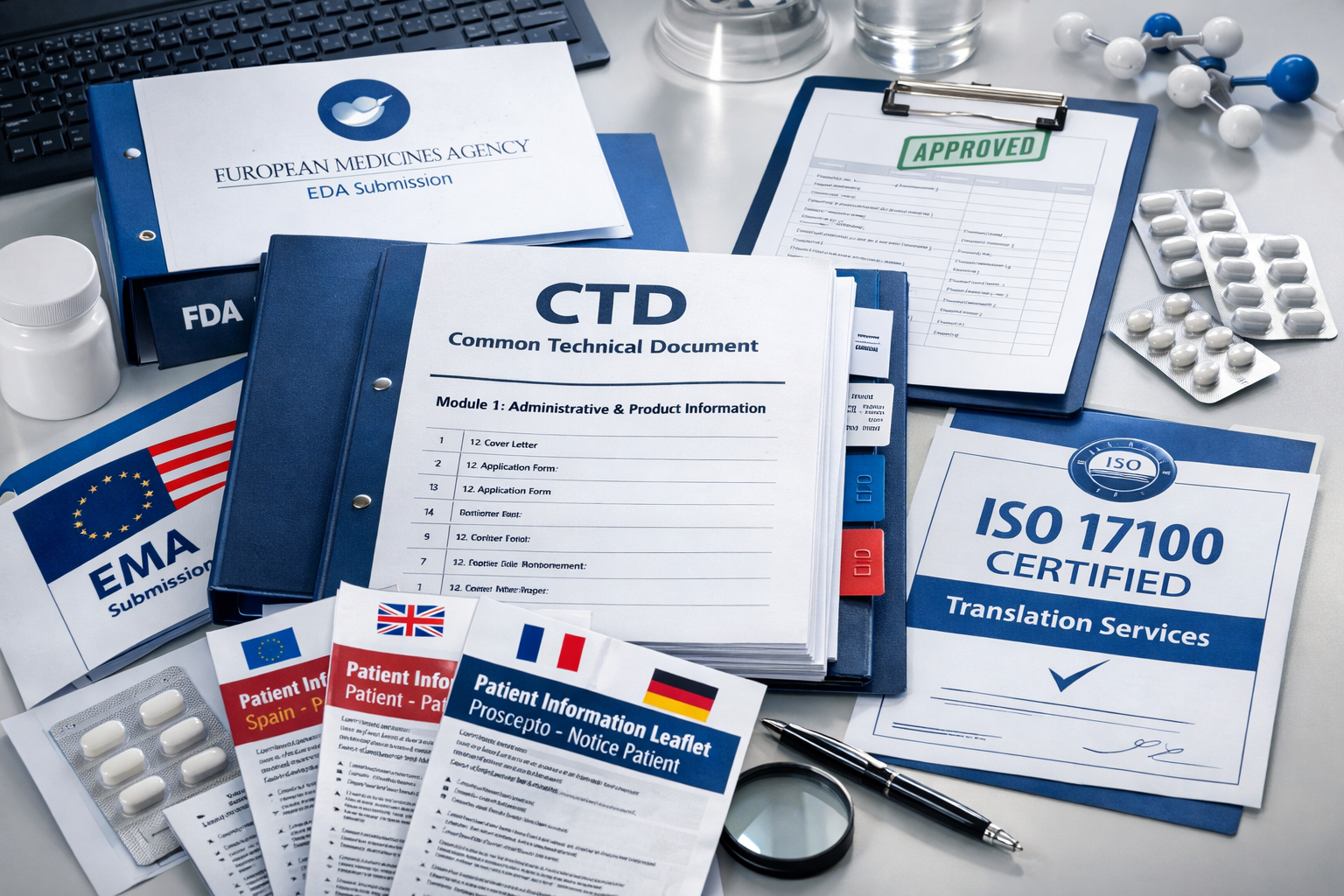
The Common Technical Document (CTD) is organised into five modules. Not all sections require translation for centralised procedures, but several documents must be available in English and in the official languages of the Member States where the product will be marketed.
Documents most commonly subject to translation include:
- Summary of Product Characteristics (SmPC): required in the language of each Member State where the product is authorised.
- Package leaflet: mandatory in national languages, and subject to user readability testing in most Member States.
- Labelling: outer and inner packaging, translated and adapted for each market.
- Non-clinical and clinical study reports (Modules 4 and 5): typically submitted in English for centralised procedures.
- Quality documentation (Module 3): specifications, analytical methods, validation reports.
- Scientific opinions and authority correspondence: where originated in another language, these may require translation into English.
Pharmaceutical translation in this context is not general-purpose translation. It requires direct knowledge of the European regulatory framework, terminology validated against EMA guidance, and rigorous consistency across every document in the dossier.
Linguistic and regulatory requirements to plan for
The EMA publishes its own templates and controlled terminology. The SmPC, package leaflet, and labelling follow fixed structures defined in the QRD (Quality Review of Documents) templates. Any deviation from the current QRD template, whether in structure, section order, or mandatory wording, is likely to generate observations during assessment.
For centralised procedures, the EMA's working language is English. For mutual recognition and decentralised procedures, patient information documents must be provided in the languages of all Member States involved. A single dossier covering multiple markets can require translations into 20 or more language variants simultaneously.
Translators working on these documents need to know the differences between QRD template versions, the requirements set out in Eudralex Volume 2C, and the EMA's guidance on plain language in package leaflets. Technical accuracy alone is not enough: the leaflet must be understood by a patient with no medical background, which demands a different review process from the one applied to clinical study reports. This combination of regulatory literacy and patient-centred writing is a defining feature of pharmaceutical regulatory translation for EMA, FDA and INFARMED submissions.
Organisations managing multiple regulatory submissions also need to ensure terminological alignment with previously submitted clinical trial documentation. Inconsistencies between a trial protocol and the corresponding Module 5 content are a recurring friction point in EMA assessments. The same discipline applies across therapeutic areas and submission types, as those familiar with translating clinical trial protocols for regulatory submission will recognise.
Common errors that delay regulatory review
Dossiers with translation-related issues tend to show recognisable patterns:
- Inconsistent terminology across modules: the same compound referred to by different names in different sections of the same dossier.
- Deviations from the QRD template: reordered sections, altered headings, or omitted mandatory phrases.
- Literal translation of regulatory expressions: terms with an established validated equivalent in the target language rendered instead as a direct calque from English.
- Version control failures: the dossier is updated but not all translated documents reflect the current revision.
- Package leaflet without readability testing: in several Member States, testing with real patients is a regulatory requirement before final approval.
These problems do not typically arise from poor linguistic translation. They arise from working with translators who have no experience in the pharmaceutical regulatory environment and no translation memory infrastructure to maintain consistency across a multi-module dossier over time.
The right translation process for regulatory dossiers
A sound process for this type of work starts with ISO 17100, which requires translation and independent revision by two qualified professionals. For pharmaceutical regulatory submissions, that baseline needs to be extended with terminology management, document version control, and regulatory review by specialists with direct EMA experience.
A recommended workflow includes:
- Terminology glossary creation and validation, aligned with QRD templates and the applicant's internal controlled vocabulary.
- Translation using project-specific translation memories, ensuring consistency across all modules.
- Revision by a second translator with demonstrated experience in pharmaceutical regulatory documentation.
- Terminological quality control, combining automated checks with manual review.
- Update management: when the dossier is revised, only modified segments are retranslated, with full traceability.
This level of process rigour is consistent with what is required in other regulated sectors. Those who have worked through medical device documentation translation for MDR compliance will find the logic familiar, though EMA-specific requirements for medicinal products carry their own particularities.
How M21Global supports EMA regulatory submissions
M21Global has worked with pharmaceutical companies, CROs, and regulatory consultancies on marketing authorisation dossier translation for EMA submission for over 20 years. The pharmaceutical translation team has direct experience with the CTD format, QRD templates, and the linguistic requirements of centralised, mutual recognition, and decentralised procedures.
ISO 17100:2015 certification (Bureau Veritas) means every project follows a documented translation and revision process. Translation memories and glossaries are maintained per project and per client, ensuring consistency across dossiers and across updates throughout the product's regulatory lifecycle.
Contact M21Global to request a quote for your regulatory dossier translation: m21global.com/en/services/pharmaceutical-translation.
Related Services
Request a free medical translation quote