- What is at stake when training is not understood
- Which documents require translation in this context
- Choosing the right level of service
- How to prepare materials for efficient translation
- M21Global: health and safety training translation with technical precision
- Related Services
- Frequently Asked Questions
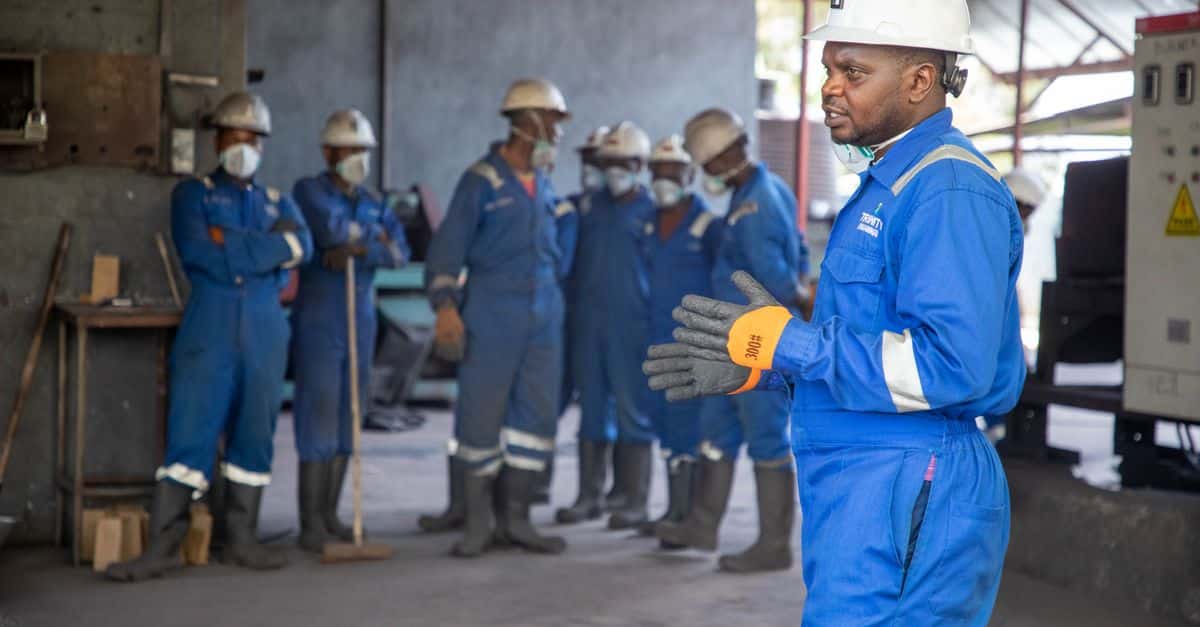
When a company employs foreign workers in roles that involve physical, chemical, or mechanical hazards, health and safety training must reach every employee in a language they understand. This is not a matter of courtesy: it is a legal requirement and, in many cases, a condition of operating licences or client contracts.
What is at stake when training is not understood
Health and safety legislation in most EU member states, including Portugal's Lei n.º 102/2009, requires that workers receive adequate training in occupational health and safety and that they genuinely understand it. When materials exist only in the company's working language and the workforce includes speakers of English, French, Arabic, Romanian, or any other language, the employer faces two distinct risks: the risk of an accident caused by misunderstanding, and the risk of regulatory non-compliance with the relevant labour inspectorate.
For companies operating across borders, or those with subsidiaries and joint-venture partners in other markets, this challenge scales. A subsidiary in Angola or Brazil must meet the same safety standards as the parent company, but in a different linguistic and cultural context. The training materials that work in Lisbon or London will not automatically work in Luanda or São Paulo without careful linguistic adaptation.
Which documents require translation in this context
Health and safety training materials are more varied than they appear at first glance. The list typically includes:
- Safety manuals and safe working procedures (including PPE instructions)
- Safety data sheets (SDS), governed by REACH and CLP regulations
- Emergency response and evacuation plans
- E-learning content and training presentations (PowerPoint, SCORM modules, videos requiring subtitles or voiceover)
- Knowledge assessment tests and compliance questionnaires
- Training records and acknowledgement declarations
- Safety signage and posters
Each format carries its own requirements. An SDS has a structure regulated by REACH and CLP; an e-learning module requires adaptation to the learning management system (LMS) in use; a training video may need subtitling, voiceover recording, or dubbing. Translating these materials is not a straightforward linguistic exercise. It requires technical knowledge of occupational health and safety, standardised terminology, and in many cases a review of compliance with the regulatory requirements of the target country.
Choosing the right level of service
Not every health and safety document demands the same level of rigour. The appropriate service level follows the potential impact of an error.
For critical procedural manuals, safety data sheets, and emergency plans, an error has direct consequences for people's safety. These documents justify a process with independent review and formal quality control, such as the workflow required under ISO 17100. An error in instructions for handling hazardous substances can cost a life or expose the company to serious civil liability.
For general awareness e-learning content or lower-risk internal materials, a process with a qualified linguist and self-review may be sufficient, provided the safety terminology has been standardised and validated beforehand.
For large volumes of reference material or content under development, AI translation with selective human review can process content quickly without compromising the essentials. This level is not appropriate for critical safety instructions.
The correct decision requires mapping each document type to its risk level before selecting a service. Companies that treat all training materials as equivalent to routine administrative documents make a common and potentially costly mistake.
How to prepare materials for efficient translation
Translation quality and turnaround time depend heavily on how documents are delivered. Several practices reduce both cost and lead time:
- Provide files in editable formats (Word, PowerPoint, InDesign, SCORM source files) rather than scanned PDFs
- Share any terminology glossaries already approved by the health and safety department
- State clearly the target country and the audience profile (literacy level, professional sector)
- Flag any country-specific regulatory requirements in the target market
- Consolidate all target languages into a single request to support terminological consistency across the project
Organisations without prior experience in translating health and safety content tend to underestimate the importance of a validated glossary. Terms such as "personal protective equipment", "lockout/tagout", or "exposure limit value" have precise equivalents in each language that must remain consistent across every document in the set.
M21Global: health and safety training translation with technical precision
M21Global translates health and safety training materials for Portuguese companies with international workforces and for foreign groups with operations in Portugal and in Portuguese-speaking markets. With over 20 years of experience and business translation services certified to ISO 17100:2015 by Bureau Veritas, the team ensures that critical safety content reaches the worker with the technical precision it demands. Language pairs cover European Portuguese, British English, Spanish, French, German, Arabic, and other languages relevant to the markets where clients operate. For companies expanding into Portuguese-speaking markets, the approach to safety documentation follows the same rigour applied to contracts and regulatory documents in those markets. Contact M21Global to request a quote for your organisation's health and safety training materials and receive a proposal matched to your volume, languages, and document criticality.
Related Services
Request a free internationalisation quote
- Request a free internationalisation quote
- Certified Translation Company Registration Angola Iape
- Translating Contracts Angolan Market
- A Translation Company Speeds Up The Internationalisation Of Your Business
Frequently Asked Questions
Is it a legal requirement to translate health and safety training for foreign workers?
In most EU countries, including Portugal, legislation requires that occupational health and safety training is genuinely understood by all workers. Where the workforce includes speakers of other languages, employers must ensure materials are accessible in those languages or risk regulatory non-compliance.
What level of translation is appropriate for safety data sheets (SDS)?
Safety data sheets have a structure regulated by the REACH and CLP regulations and require technical translation with independent review. A process compliant with ISO 17100 is recommended given the direct impact on personal safety.
Can e-learning health and safety modules be translated?
Yes. Translating e-learning modules includes linguistic adaptation of on-screen text, subtitling or voiceover recording, and ensuring compatibility with the LMS in use. Providing editable source files (SCORM, PowerPoint) is essential for an efficient process.
How long does it take to translate a health and safety manual?
Turnaround depends on word volume, number of target languages, file format, and service level. For critical documents with ISO 17100 review, the timeline for standard volumes is confirmed in the quote. Rush timelines can be negotiated for urgent requirements.
Do translators working on health and safety content need specific qualifications?
There is no mandatory sector-specific certification for health and safety translators, but proven technical knowledge of the field is essential. An ISO 17100-compliant process with independent review provides the strongest assurance of terminological accuracy and consistency.