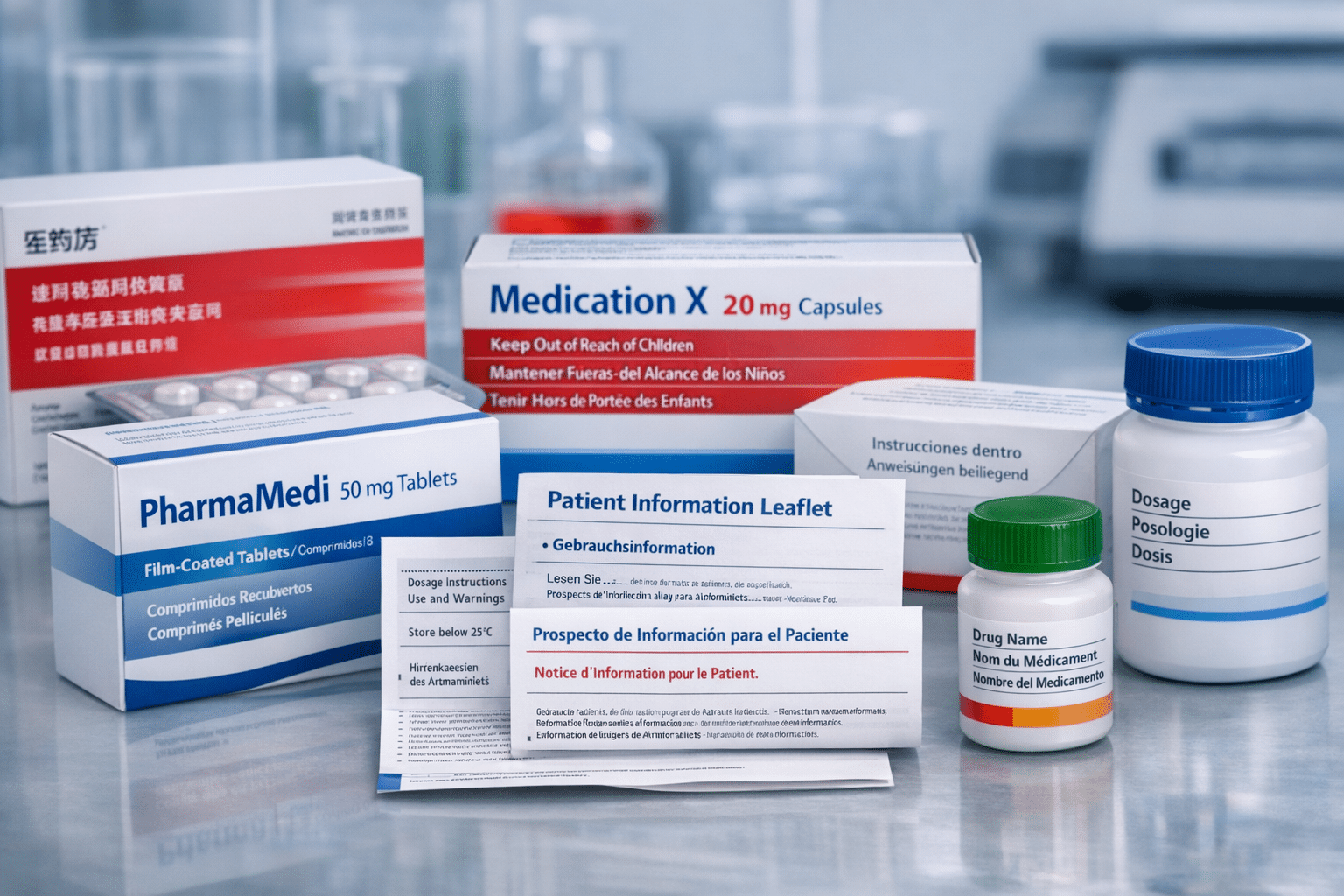
Medical Device Regulation (EU) 2017/745 requires user manuals to be available in the official language of every Member State where a device is placed on the market. For manufacturers, this is not a routine translation task. It is a regulatory obligation with direct consequences for CE marking and Notified Body audits.
What MDR requires for user manuals
Annex I of the MDR (General Safety and Performance Requirements) specifies that instructions for use must be written in the language or languages of the destination Member State. This applies to devices in classes Is, Im, IIa, IIb and III. Class I devices without a measuring or sterile function may in some cases be exempt from printed instructions, but any documentation provided is subject to the same language requirement.
The user manual forms part of the technical file reviewed by the Notified Body. An inaccurate translation, or one that is inconsistent with the source version, can produce a non-conformity finding during audit and delay or block CE marking. The risk is not theoretical. Notified Bodies review language equivalence as part of their documentation assessment.
Technical and terminological requirements
Translating MDR user manuals differs substantially from translating commercial documents. The main requirements are:
- Terminological consistency: terms must be applied uniformly throughout the document and aligned with relevant standards, including ISO 15223-1 (symbols for medical devices).
- Traceability: each translated version must reference the source version, including revision number and date. Notified Bodies may request line-by-line correspondence between source and target documents.
- ISO 17100 compliance: the translation process must follow a verifiable workflow — translation by a qualified specialist, independent review by a second translator, and final quality control. This makes the process auditable.
- eIFU management: for devices using electronic instructions for use under Regulation (EU) 207/2012, the translation must preserve the functional structure of the digital document, not only its linguistic content.
Safety-critical content, such as warnings, contraindications, and sterilisation instructions, requires particular care. An error in these sections has direct implications for patient safety and manufacturer liability.
Step-by-step: the certified translation process for MDR
A translation provider with regulatory experience works to a structured process:
- Document analysis: review of the source document to identify specialist terminology, normative references, and structure.
- Controlled glossary: creation or alignment with the manufacturer's existing glossary, covering all target languages.
- Translation by a specialist with MDR experience: language proficiency alone is not sufficient. The translator must understand the MDR and IVDR regulatory context.
- Independent review: a second specialist verifies accuracy, consistency, and equivalence with the source.
- Quality control and ISO 17100 certification: the process is documented and the project file is retained for audit purposes.
- Delivery in editable and PDF formats: to support integration into the technical file and future revisions.
This workflow applies equally when a manufacturer needs to update a manual following a design revision or a Field Safety Corrective Action (FSCA), where timelines are typically short. For a broader view of which documents require translation across the full technical file, the article on medical device documentation translation for MDR compliance covers the wider scope.
Language coverage and market-specific considerations
Manufacturers targeting the EU typically require user manuals in German, French, Italian, Spanish, Dutch, Polish, and Portuguese, among others. For Portuguese-language markets, the distinction matters:
- PT-PT (Portugal): required for placing a device on the Portuguese market. Terminology and orthography follow European Portuguese conventions.
- PT-BR (Brazil): ANVISA registration requires documentation in Brazilian Portuguese. Terminology and conventions differ from PT-PT and must be adapted accordingly, not simply converted.
For markets such as Angola or Mozambique, language requirements depend on local medical device registration legislation, which generally accepts PT-PT but may impose additional conditions.
Manufacturers expanding into multiple markets simultaneously benefit from managing all language versions within a single project, using a shared glossary and consistent source control. This reduces cost per word and simplifies version management when the document is updated.
How M21Global supports medical device manufacturers
M21Global provides pharmaceutical and medical device translation services certified to ISO 17100:2015 (Bureau Veritas) and ISO 18587, covering all EU languages and the main Portuguese-speaking markets. The process is documented and audit-ready, allowing manufacturers to present translation compliance evidence to their Notified Body without additional steps. With over 445 million words translated since 2005 and direct experience across MDR and IVDR documentation requirements, the team understands what the audit process demands. Contact M21Global to request a quote for your user manual translation project.
Related Services
Request a free medical translation quote